
Get ready for a spectacular celestial event in the pre-dawn hours of Tuesday, March 3.
A total lunar eclipse will be visible here, though the moon will be setting and the sun rising, before the eclipse ends.
But not all is lost, since we will see the best part of the event - totality, when the moon passes through the darkest part of the Earth’s shadow (known as the umbra).
As this happens, the moon turns reddish- orange, sometimes referred to as a “blood moon.”
Here’s what you need to know: Technically, the event begins at 2:44 a.m., but you probably won’t notice much until about an hour later.
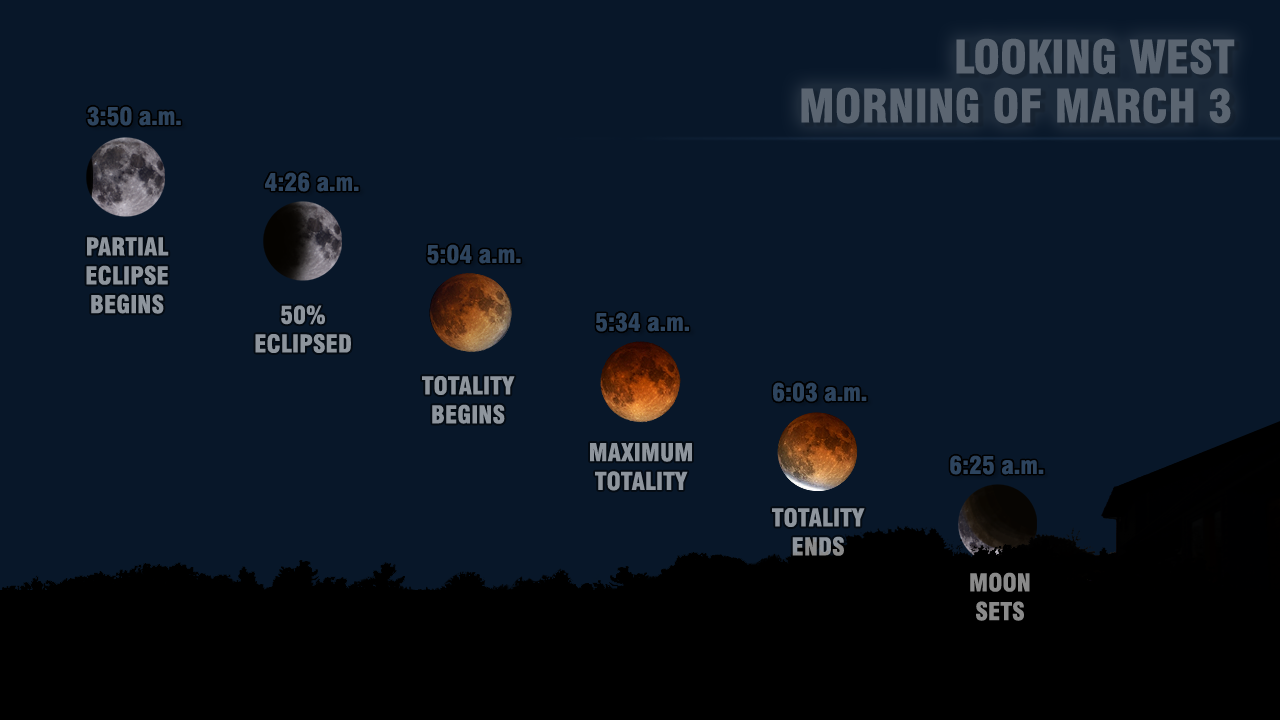
At 3:50 a.m., the moon starts to slip into the umbra, marking the beginning of the partial eclipse phase of the event. The left side of the moon will start to visibly darken.
In the ensuing one hour and 14 minutes, more and more of the moon will be turning very dark, finally reaching the start of totality at 5:04 a.m. This is when the moon turns a beautiful reddish-orange.
Maximum eclipse is at 5:34 a.m., the moon still sporting its newfound color. By now the eastern sky is just starting to brighten a bit, and the moon is getting closer to the western horizon.
Totality ends at 6:03 a.m. as the moon starts to exit the umbra, allowing the lower left side of the moon to slowly begin brightening once again.
At 6:25 a.m., the sun rises as the moon sets, with only about one third of the moon illuminated as it slips below the horizon. The remainder of the eclipse will not be seen here, but it officially ends at 8:23 a.m.
It should all be a splendid sight to see. Of course, the big unknown variable is the weather, keep your fingers crossed for clear skies.
According to NASA, the next total lunar eclipse visible here will be June 26, 2029, so enjoy this one.


Comments
No comments on this item Please log in to comment by clicking here